

Alcohol is not strictly banned for men on Mounjaro. But the medication will surely change your relationship with it.
The combination of Mounjaro and alcohol can amplify nausea, dehydration, and blood sugar swings. Your alcohol tolerance will also drop as you lose weight. Mounjaro's effect on gastric emptying means alcohol can hit later and harder than your usual pace suggests.
This is why it is worth avoiding alcohol, especially in the first month of your treatment.
But here’s another angle on the Mounjaro-alcohol story. Early research suggests that GLP-1 medicines such as tirzepatide, the active ingredient in Mounjaro, may reduce the urge to drink through the same appetite pathways. This is a research finding, not an established effect of Mounjaro at weight-management doses.
A 2026 study in eBioMedicine found it blocks dopamine spikes triggered by alcohol. A small phase 2 trial in JAMA Psychiatry (2025) of low-dose semaglutide in 48 adults with alcohol use disorder reported reduced drinking. It did not study tirzepatide or weight-management doses. GLP-1 is a gut hormone involved in appetite.
Some people on Mounjaro report drinking less. Whether the medicine causes that is not yet established.
Can you drink alcohol on Mounjaro?
Alcohol is not a strict no when taking Mounjaro. The patient information leaflet does not set a rule on alcohol. The NHS advises that it is best to avoid alcohol while using tirzepatide because it can increase side effects such as nausea or vomiting.
That advice matters most while your dose is being increased, when side effects are most common.
Mounjaro already has its own set of gastrointestinal side effects. Alcohol can amplify them, affect blood sugar, reduce your tolerance, and undermine your weight loss progress.
If you do drink, moderation and timing are what matter. An occasional drink at a manageable level may not call for a clinical emergency.
Why Mounjaro and alcohol don't mix well
It can amplify side effects significantly
Mounjaro's most common side effects include nausea, vomiting, diarrhoea, and dizziness. If you see, these are very much similar to what you feel after a boys night. Put them together and you're compounding both triggers simultaneously.
The risk is especially higher during the first few weeks of treatment and around each dose step-up when GI symptoms are already at their worst. A Friday night that'd normally be fine can become a genuinely rough evening if you're two weeks into a new dose level.
Tom, a 44-year-old sales director from Bristol, described his first experience well: "I had two pints on week three of Mounjaro. Felt fine going out, felt awful by 10pm. No more than I'd normally drink, but the nausea hit in a way I wasn't expecting. Dialled it back after that."
Dehydration risk doubles up
Dehydration often follows diarrhoea and vomiting, Mounjaro’s common side effects. Alcohol is a diuretic, meaning it actively pulls fluid from your body. Hence, the combination substantially raises dehydration risk.
This matters especially for men who are also exercising as part of their weight loss plan. Dehydration impairs muscle recovery, elevates cortisol, and worsens next-day fatigue. It's not dramatic, but it compounds.
Blood sugar can swing unpredictably
Mounjaro regulates blood sugar as a part of its mechanism. On the other hand, alcohol can cause blood sugar to drop below safe levels.
If you are also managing type 2 diabetes, insulin resistance, or metabolic syndrome, the combination creates unpredictable swings that are harder to monitor. This is a common profile for men starting treatment.
If your Mounjaro programme includes concurrent diabetes medication, you must speak to your clinician specifically about alcohol before your first drink on treatment.
Does Mounjaro affect your alcohol tolerance?
Yes and it's not what you would expect
Mounjaro doesn’t lower your alcohol tolerance directly. But the weight loss caused by it does. As your body weight decreases, the same amount of alcohol produces a higher blood alcohol concentration.
Studies on patients who've experienced significant weight-loss consistently show this effect. Their blood alcohol levels can rise substantially after losing significant body mass. The way alcohol hits your body after a 10-20% weight loss can be surprising for many men.
We’re not talking about minor adjustments here. For example, if you were a solid two-pints-and-fine man before starting treatment, you may find you're a one-and-done man six months in.
Gastric emptying changes how it hits
The primary effect of Mounjaro is slow gastric emptying to keep you full for a longer time. This means that even alcohol gets processed slowly inside the body.
You may feel relatively fine for the first hour, then the full effect arrives later than you'd expect. Men drinking at their usual pace can find themselves significantly more affected by the end of the evening than the start suggested.
Does Mounjaro affect alcohol cravings? What the research shows
This is the part that most prescribers are not paying much attention to.
What the science shows
GLP-1 receptors are found not just in the gut and pancreas but in the brain’s reward system too: the mesolimbic dopamine pathway. Alcohol triggers a dopamine release in this system, which is what makes us feel good and crave for more. In animal studies, GLP-1 and GIP receptor agonists (medicines that act on these hormone receptors) appear to dampen that dopamine response.
The evidence so far is early, and most of it comes from animals or from observational records:
- A 2026 study in eBioMedicine (University of Gothenburg, Sweden) tested tirzepatide on alcohol behaviours in rats and mice. The animals drank less alcohol and showed less relapse-like drinking, and tirzepatide dampened alcohol's effect on dopamine. It was an animal study. Nothing in it shows what happens in people.
- A randomised clinical trial published in JAMA Psychiatry (Hendershot et al., April 2025) gave low-dose semaglutide or placebo to 48 adults with alcohol use disorder. Over nine weeks, semaglutide reduced weekly craving, drinks per drinking day and the amount drunk in a laboratory session. It did not change the number of drinking days, and it did not study tirzepatide or weight-management doses.
- An analysis of US Veterans Affairs health records (Journal of Clinical Investigation, 2025) linked GLP-1 receptor agonists to lower scores on a drinking questionnaire. Tirzepatide was not among the medicines studied. A separate records study compared semaglutide with other weight-loss medicines (Nature Communications, 2024). It linked semaglutide to a 50 to 56% lower rate of alcohol use disorder diagnoses over 12 months. Both are observational: they show association, not cause.
Mounjaro is not prescribed as an alcohol treatment. The human research is early, and the trials published so far used other GLP-1 medicines, not tirzepatide. Some people on Mounjaro say they drink less; whether the medicine causes that is not established.
Mounjaro is licensed for weight management and type 2 diabetes only; any effect on drinking is a research finding, not a treatment benefit.
How to drink alcohol on Mounjaro
Timing around your injection
Side effects are most common when you first start tirzepatide and after each dose increase, and they decrease over time for most people. There is no official waiting time after an injection. Here is a cautious way to time alcohol on Mounjaro:
- First month of treatment: avoid alcohol as much as possible while your body adjusts to the medication
- After each dose increase: treat it like the first month until the side effects settle
- Never drink on an empty stomach on Mounjaro. Always eat a proper meal first
- Stay well hydrated before, during, and after drinking
Recommended alcohol limit on Mounjaro
The alcohol limit recommendation according to the UK clinical guidance is a maximum of 14 units per week for adults, spread across several days. On Mounjaro, a cautious practical ceiling is lower: one or two moderate drinking occasions a week at most. Avoid binge patterns (three or more drinks in one sitting) entirely.
HeMed highly recommends resistance training as part of your programme, to preserve muscle mass. If you train, you should know that alcohol impairs muscle protein synthesis, elevates cortisol, and disrupts sleep. It negates the training efforts.
Who should avoid alcohol entirely on Mounjaro?
Please avoid alcohol if you’re on Mounjaro and -
- You are in your first month of treatment. Your body needs to establish a response to the medication without added variables. The side effect risk is highest in this window.
- You have type 2 diabetes or are managing insulin resistance. Alcohol causes unpredictable blood sugar drops that are dangerous alongside blood sugar-regulating medication.
- You are experiencing significant GI side effects including nausea, vomiting, diarrhoea. Alcohol will make these substantially worse. Wait until side effects have settled (typically 4–8 weeks) before saying yes to any party.
- You have a personal or family history of pancreatitis. A history of pancreatitis is a warning in Mounjaro's UK product information, and alcohol is one of the primary triggers of acute pancreatitis.
To avoid any confusion, you can consult our clinicians at HeMed before drinking on treatment.
HeMed's clinician-led programme includes mandatory blood tests before prescribing and at 6 and 12 months. This way we can actually see what's happening to your metabolic markers, not just your weight.
If alcohol or any other aspect of your lifestyle is affecting your progress, your clinician can help you work around it.
Frequently asked questions
Can you drink alcohol on Mounjaro?
There is no ban. The NHS says it is best to avoid alcohol while using tirzepatide because it can increase side effects such as feeling or being sick. The patient information leaflet sets no rule on alcohol. Side effects are most common when you start and after each dose increase, so that is when the advice matters most.
Alcohol can amplify Mounjaro's GI side effects (nausea, vomiting, dizziness), affect blood sugar, and undermine weight loss progress. If you do drink:
- skip it while you are starting treatment or moving up a dose
- eat a proper meal first
- stay hydrated
- stick to no more than one to two occasions per week
Does Mounjaro affect your alcohol tolerance?
Indirectly, yes. Mounjaro itself doesn't lower your tolerance, but the weight loss it drives does. As your body weight decreases, the same amount of alcohol produces a higher blood alcohol concentration.
Men who have lost 10%+ of their body weight on Mounjaro often find beer, wine, or spirits hits noticeably harder than before. Mounjaro also slows gastric emptying, which means alcohol effects can arrive later in the evening than expected.
What are the side effects of Mounjaro and alcohol combined?
Nausea, vomiting, diarrhoea, and stomach cramps are all more likely when you combine Mounjaro's effects with alcohol. Dehydration risk also increases significantly, as both have dehydrating effects.
For men managing diabetes or insulin resistance, blood sugar swings from alcohol add a further risk. Binge drinking is particularly inadvisable on any GLP-1 medication.
Does Mounjaro stop alcohol cravings?
No study has tested this in people taking tirzepatide. In rats and mice, tirzepatide reduced alcohol intake and dampened the dopamine response to alcohol (eBioMedicine, 2026). Animal findings do not show what happens in people.
A small phase 2 trial in JAMA Psychiatry (2025) gave low-dose semaglutide, a different GLP-1 medicine, to 48 adults with alcohol use disorder. It ran for nine weeks and reported less craving and less drinking on some measures. It did not study tirzepatide or weight-management doses. Mounjaro is licensed for weight management and type 2 diabetes only. Whether it changes drinking in men taking it for weight is not established.
How long after a Mounjaro injection can I drink?
There is no official waiting time after an injection. Neither the patient information leaflet nor the NHS sets one. The NHS advice is that it is best to avoid alcohol while using tirzepatide. Side effects such as nausea are most common when you first start and after each dose increase, and they ease over time for most people. Those are the weeks to avoid it.
If you do drink once you are settled on a dose, eat first, drink water alongside, keep it small and never binge. Ask your clinician if you are unsure.
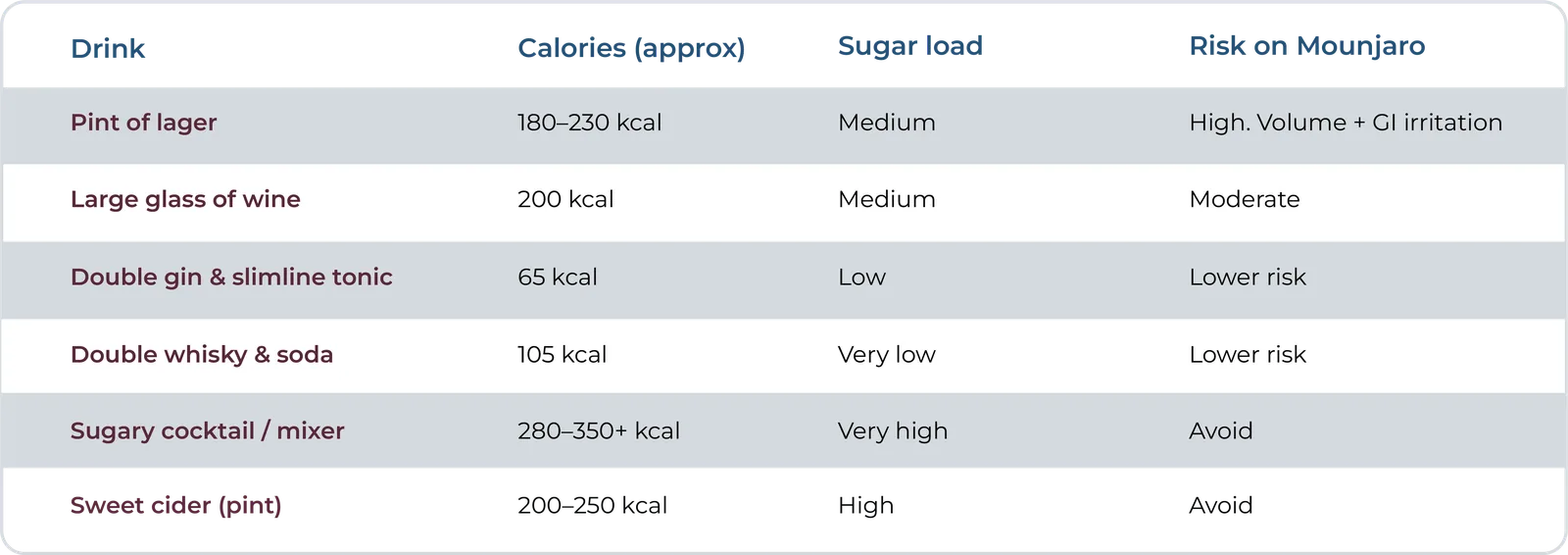
What's the best alcohol to drink on Mounjaro?
Lower-risk choices:
- gin and slimline tonic (around 65 kcal per measure)
- whisky and soda water
- vodka with a zero-calorie mixer
- light or low-alcohol beer
- dry wine in a small measure
Strictly avoid:
- sugary cocktails
- sweet ciders
- drinks with full-sugar sodas or fruit juice
- energy drink mixers
Can you drink beer on Mounjaro?
You can, but keep it minimal. Standard lager contains 180–230 calories per pint with a moderate carbohydrate load. The carbonation can worsen nausea if your GI side effects haven't fully settled.
Light or low-alcohol beer is a better choice if you want something in a glass. Avoid it while you are starting treatment or moving up a dose, eat a proper meal first, and stick to one or two at most.
Sources (10)
- Edvardsson C et al., Tirzepatide reduces alcohol drinking and relapse-like behaviours in rodents. eBioMedicine (The Lancet), February 2026.
- Hendershot CS et al., Once-weekly semaglutide in adults with alcohol use disorder: a randomised clinical trial. JAMA Psychiatry, April 2025.
- Farokhnia M et al., GLP-1 receptor agonists reduce alcohol intake. Journal of Clinical Investigation, March 2025.
- University of Gothenburg, Reduced alcohol consumption with Mounjaro's active substance. gu.se, 2026
- Mounjaro (tirzepatide) patient information leaflet. MHRA.
- NHS, Alcohol units and safe drinking guidelines.
- Diabetes UK, Alcohol and diabetes.
- NICE, Technology Appraisal TA1026 (tirzepatide for managing overweight and obesity).
- Wang W et al., Associations of semaglutide with incidence and recurrence of alcohol use disorder. Nature Communications, 2024.
- NHS, Tirzepatide, section "Food, drink and alcohol with tirzepatide". nhs.uk, page last reviewed 15 May 2026.
The reference list as published with the article. Statistics describe populations, not any one person’s results.
HeMed is a clinician-led weight loss and metabolic health service for men in the UK, built around an at-home blood test. All clinicians are UK-registered. This article is for information only and does not constitute medical advice. Always consult a qualified clinician before starting or changing any treatment.